Tuesday, May 3, 2011

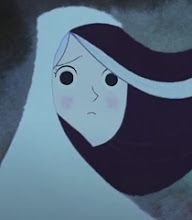
like the passionate daughter of a lighthouse keeper


It is a bright house;
not a single room is dim.
It is a house which rises high
on the cliffs, open
as a lookout tower.

When the night comes
I put a light in it,
a light larger than the sun and the moon.

Think
how my heart leaps
when my trembling fingers
strike a match in the evening.

I lift my breasts
and inhale and exhale the sound of love
like the passionate daughter of a lighthouse keeper.

It is a bright house.
I will create in it
a world no man can ever build.

-Fukao Sumako "Bright House" translated by Kenneth Rexroth

Image via Crush Cul de Sac

Sunday, April 17, 2011

Compared to the pain Tsugumi gives me, this is nothing at all


Everyone gets annoyed about something at least once a day, me included. But I noticed there was something I did whenever this happened to me - that there was a sentence I would start chanting over and over deep down inside, like a sort of Buddhist chant, without even realizing that I was doing it. Compared to the pain Tsugumi gives me, this is nothing at all. It seemed that during the years I spent with Tsugumi, my body had come to understand in a hazy sort of way that, in the end, getting worked up really doesn't take you anywhere. And there was something else that I understood as I stared into the orange light of the gradually darkening sky - something that made me feel sort of like I wanted to cry.

Excerpt from Goodbye Tsugumi by Banana Yoshimoto translated from the Japanese by Michael Emmerich.

Rereading a favorite Yoshimoto book this sunny afternoon. This story has always been poignant, but recent events has made this even more true. Sitting here I can imagine Tsugumi's response to my musings, probably something along the lines of , "God you're a moron! Keep your mouth shut unless you've got something worth saying." Gallant, wise, and surprisingly unpleasant, Tsugumi is one of my literary heros.

image via

Saturday, April 16, 2011

The best way to eat squid is to catch it first


best if you pull it out of the dripping net yourself,
a gift you didn’t ask for among the ordinary
bone-filled catch you did, and the purple sea-stars, inedible
bad luck you didn’t deserve.
Next to eat squid you waste a fire
To coals, nestling the flaccid bodies
Into the earth for as long as it takes, usually
long. Finally you may eat the small charred
legs, one by one, working your way
to the ink-filled heart. This is a shared
humiliation, and at this stage you are obliged
to press your lips to any nearby lover,
mark him as indelibly as you can.

Suzanne Matson "Squid"

image via

Friday, April 15, 2011

a wedding in a field-the old saying:


 it's good luck to be seen from a train dressed in white, you must be looking the other way, so many things work only if you're looking away. A woman in a field is walking away.
Gardens early in the evening. Trees
planted a few hundred years ago to line a road no longer there
. The water is pale teal, light, field after field. Spire, steeple, sea

of trees that line roads long disappeared along with their houses, which were
great houses in their time.

Cole Swensen from "Five Landscapes Two"

image via

Tuesday, April 5, 2011

To have picked up my heavy hem and run


To have been age enough.
To have been leg enough.
Been enough bold. Said no.
Been a girl grown into that
negative construction. Or said yes
on condition of a dress. To be yours
if my skirts skimmed the floors.
To have demanded each seam
celestial, appealed for planetary pleats.
And when you saw the sun a sequin,
the moon a button shaped from glass,
and in the stars a pattern
for a dress, when the commission
proved too minute, and the frocks
hung before me like hosts,
to have stood then at the edge
of the wood, heard a hound’s bark
and my heart hark in return.
To have seen asylum in the scruffs
of neck—mink, lynx, ocelot, fox,
Kodiak, ermine, wolf—felt a claw
curve over my sorrow then. Said yes
on condition of a dress. To be yours
if my skirts skimmed the floors.

-Stacy Gnall excerpt from "Self-Portrait as Thousandfurs"

image via

Thursday, March 31, 2011

the sound of the grass growing in the sun


Oh you will wake up some morning
to the sound of the grass growing in the sun
Oh your hair became darker
And your head is riding higher than it’s ever been
Oh your legs are running
And your stride is wider
Wider than you’ve ever known,
Oh the robins flying are
Building their nests out of your childhood.

-Joseph Pintauro “Box of Sun”

Image via

Thursday, March 24, 2011

Did you too see it, drifting, all night, on the black river?


Did you see it in the morning, rising into the silvery air -
An armful of white blossoms,
A perfect commotion of silk and linen as it leaned
into the bondage of its wings; a snowbank, a bank of lilies,
Biting the air with its black beak?
Did you hear it, fluting and whistling
A shrill dark music - like the rain pelting the trees - like a waterfall
Knifing down the black ledges?
And did you see it, finally, just under the clouds -
A white cross Streaming across the sky, its feet
Like black leaves, its wings Like the stretching light of the river?
And did you feel it, in your heart, how it pertained to everything?
And have you too finally figured out what beauty is for?
And have you changed your life?


Mary Oliver "The Swan"
Image by Laura Makabrescu

Wednesday, March 16, 2011

I never though Michiko would come back


after she died. But if she did, I knew
it would be as a lady in a long white dress.
It is strange that she has returned
as somebody's dalmatian. I meet
the man walking her on a leash
almost every week. He says good morning
and I stoop down to calm her. He said
once she was never like that with
other people. Sometimes she is tethered
on their lawn when I go by. If nobody
is around, I sit on the grass. When she
finally quiets, she puts her head in my lap
and we watch each other's eyes as I whisper
in her soft ears. She cares nothing about
the mystery. She likes it best when
I touch her head and tell her small
things about my days and our friends.
That makes her happy the way it always did.

Jack Gilbert "The Great Fires"

Images via Beklina and We Heart It

Thursday, March 3, 2011

The Very Nervous Family


Mr. Horowitz clutches a bag of dried apricots to his chest. Although the sun is shining, there will probably be a storm. Electricity will be lost. Possibly forever. When this happens the very nervous family will be the last to starve. Because of the apricots. "Unless," says Mrs. Horowitz, "the authorities confiscate the apricots." Mr. Horowitz clutches the bag of dried apricots tighter. He should've bought two bags. One for the authorities and one for his very nervous family. Mrs. Horowitz would dead bolt the front door to keep the authorities out, but it is already bolted. Already dead. She doesn't like that phrase. Dead bolt. It reminds her of getting shot before you even have a chance to run. "Everyone should have at least a chance to run," says Mrs. Horowitz. "Don't you agree, Mr. Horowitz?" Mrs. Horowitz always refers to her husband as Mr. Horowitz should they ever one day become strangers to each other. Mr. Horowitz agrees. When the authorities come they should give the Horowitzs a chance to run before they shoot them for the apricots. Eli Horowitz, their very nervous son, rushes in with his knitting. "Do not rush," says Mr. Horowitz, "you will fall and you will die." Eli wanted ice skates for his birthday. "We are not a family who ice skates!" shouts Mrs. Horowitz. She is not angry. She is a mother who simply does not wish to outlive her only son. Mrs. Horowitz gathers her very nervous son up in her arms, and gently explains that families who ice skate become the ice they slip on. The cracks they fall through. The frost that bites them. "We have survived this long to become our own demise?" asks Mrs. Horowitz. "No," whispers Eli, "we have not." Mr. Horowitz removes one dried apricot from the bag and nervously begins to pet it when Mrs. Horowitz suddenly gasps. She thinks she may have forgotten to buy milk. Without milk they will choke on the apricots. Eli rushes to the freezer with his knitting. There is milk. The whole freezer is stuffed with milk. Eli removes a frozen half pint and glides it across the kitchen table. It is like the milk is skating. He wishes he were milk. Brave milk. He throws the half pint on the floor and stomps on it. Now the milk is crushed. Now the milk is dead. Now the Horowitzs are that much closer to choking. Mr. and Mrs. Horowitz are dumbfounded. Their very nervous son might be a maniac. He is eight. God is punishing them for being survivors. God has given them a maniac for a son. All they ask is that they not starve, and now their only son is killing milk. Who will marry their maniac? No one. Who will mother their grandchildren? There will be no grandchildren. All they ask is that there is something left of them when they are shot for the apricots, but now their only son is a maniac who will give them no grandchildren. Mr. Horowitz considers leaving Eli behind when he and Mrs. Horowitz run for their lives.

Sabrina Orah Mark "The Very Nervous Family"

Image via